
BLOG
Knowledge
Technology and Services
Why AI Data Center fuels the demand for Liquid Cooling and Cold Plate?
2026-08-21
How do AI Data Centers drive the demand for Liquid Cooling and Cold Plates?
AI Data Centers increasingly use more GPUs and high-performance processors within the same system. As computational power increases, the amount of heat to be dissipated per unit of space also rises. In high-power density racks, simply increasing airflow and fan power is becoming increasingly difficult to effectively meet cooling requirements.Liquid Cooling addresses this challenge by bringing the coolant closer to the heat source. With Direct-to-Chip Cooling, Cold Plates are placed directly on GPUs, CPUs, or other large heat-generating chips. Coolant flowing inside the Cold Plate absorbs heat and transfers it out of the server.Therefore, the development of AI Data Centers not only creates demand for new cooling systems but also opens up demand for components such as Liquid Cold Plates, while imposing new requirements on precision machining technology, creating coolant channels, joining, and product quality control.
Why do AI Data Centers create a more challenging cooling problem?
Unlike many traditional server systems primarily relying on CPUs, AI infrastructure uses a large number of GPUs and accelerators to perform parallel computations for AI model training and operation.When multiple high-power processors are integrated into the same rack, two factors simultaneously increase:Increased computational density→ increased power consumption per rack→ increased heat generation→ increased thermal density to be managed.Meanwhile, the physical size of the rack and the space for airflow cannot increase proportionally.This is why cooling is increasingly becoming a critical factor in AI infrastructure design.Quote: NVIDIA announced the Vera CPU Rack system in a rack configuration using 100% liquid cooling, while the Vera Rubin platform is also designed with rack-level liquid cooling architecture. (*) NVIDIA – one of the world's leading developers of GPUs and AI computing platforms – is increasingly integrating liquid cooling into new-generation AI systems.
Why is simply increasing fans and airflow not enough?
In air cooling systems, heat from the GPU or CPU typically has to transfer through multiple steps:GPU / CPU→ thermal interface material→ heatsink→ air→ Data Center cooling system.When heat increases, one approach is to increase the amount of air passing through the heatsink. However, airflow cannot be increased indefinitely. Servers have limited space for: GPUs; CPUs; memory; power supplies; network components; heatsinks; fans; and other components. As component density increases, the airflow path also becomes more restricted. To dissipate more heat, fan airflow and pressure must be increased, which means consuming more power and making the airflow design problem more complex.Therefore, for high-power density AI racks, the issue is no longer simply “adding more fans”, but rather how to remove heat from the chip more effectively.
How does Liquid Cooling solve the thermal problem of AI Servers?
A key difference of Liquid Cooling is bringing the coolant closer to the heat source.In Direct-to-Chip Liquid Cooling:GPU / CPU / Switch Chip↓Cold Plate↓Coolant↓Manifold↓CDU – Coolant Distribution Unit↓External heat dissipation systemCold Plates are placed in direct contact with large heat-generating components such as GPUs, CPUs, or Switch Chips. Coolant flowing inside the Cold Plate will absorb heat from the chip, then transfer the heat out through a circulation and heat dissipation system.Compared to Air Cooling, Direct-to-Chip Liquid Cooling helps bring the coolant closer to the heat source. As a result, heat transfer can occur in the direction of:Chip → Cold Plate → Coolantinstead of primarily transferring heat through:Chip → Heatsink → Air.Shortening the heat transfer path and using liquid to transport heat are among the reasons why Liquid Cooling is gaining increasing attention for high-power density AI Data Centers.
What is a Cold Plate?
A Cold Plate is a heat exchange component placed in contact with a heat source, with internal channels for coolant to circulate and carry heat away from the component.In AI servers, Cold Plates can be used for: GPUs; CPUs; Switch chips; Other high-power electronic components. A Cold Plate not only needs good heat transfer. When liquid circulates inside, the product must also meet many requirements related to:
- leak tightness;
- flatness;
- dimensional accuracy;
- coolant channels;
- ability to withstand operating conditions;
- consistency between products.
Therefore, as the demand for Liquid Cooling increases, so do the requirements for Cold Plate manufacturing technology.
Why is Cold Plate demand increasing with AI Data Centers?
Increased thermal power to be managed per rack
AI Data Centers concentrate many high-performance GPUs within the same system. As the total power of the rack increases, the cooling system must collect and transport a larger amount of heat.The Cold Plate becomes one of the most critical interfaces between: heat-generating chips and Liquid Cooling systems.
More components may require direct cooling
Liquid Cooling may initially focus on the largest heat-generating components such as GPUs and CPUs. However, as power density continues to increase, cooling architectures tend to expand their heat capture scope.Quote: NVIDIA states that the Rubin generation aims for a 100% liquid-cooled architecture, including both compute and networking components instead of focusing only on individual chips.=> This indicates that the demand for thermal management in AI Data Centers is expanding from the chip level to the server and rack level.
Cooling Channels are increasingly becoming a critical part of Cold Plate design
Inside the Cold Plate, coolant needs to be distributed to the areas where heat needs to be removed. Therefore, the efficiency of a Cold Plate depends not only on the material but also on the design of:
- cooling channel location;
- channel geometry;
- flow cross-section;
- heat exchange area;
- coolant path.
This is where precision CNC machining can play a crucial role.Cooling channels can be machined directly onto the base of the Cold Plate before being sealed with a cover.
How can a Cold Plate be manufactured?
Depending on the structure and manufacturing method, the process will vary. For Cold Plates using a base with cooling channels and a cover plate, one manufacturing approach may include:
1. Base Plate Machining
↓
2. CNC Machining for Cooling Channels
↓
3. Cover Plate Preparation
↓
4. Cover-to-Base Joining
↓
5. Finishing Machining if needed
↓
6. Product Inspection
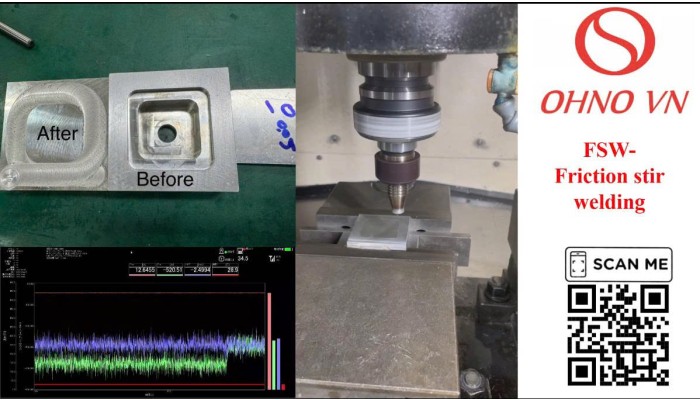
One of the technologies that can be used to join the cover to the aluminum base is Friction Stir Welding – FSW. Commercial FSW applications for Liquid Cold Plates also use a structure consisting of a body with coolant channels and a cover joined by FSW.
What role does Friction Stir Welding (FSW) play in Cold Plate manufacturing?
FSW is a solid-state joining method.A specialized tool rotates at high speed, contacts the joint area, and generates heat due to friction. The material in this area softens but does not need to melt completely. The tool's movement causes the material to move and stir, forming a joint.This creates a notable manufacturing approach for aluminum Cold Plates:CNC machining to create Cooling Channels+FSW to seal the Cover Plate.Here, CNC and FSW perform two different but complementary tasks:
- CNC machining: creating the shape and coolant channels;
- FSW: creating the joint between the base and cover.
Therefore, a Cold Plate is a typical example of how a thermal management component may require a combination of precision machining and joining technology.
Why does FSW have potential for Aluminum Cold Plates?
Leak tightness of coolant channels
Coolant is routed through channels inside the Cold Plate. Therefore, the joint between the cover and base needs to be controlled to minimize the risk of leakage. FSW creates a joint without completely melting the base material. For aluminum, this is one of the reasons why this technology is used in Liquid Cold Plate and heat exchanger applications.
Control of distortion and flatness
Cold Plates must be in contact with the components to be cooled. Therefore, the flatness of functional surfaces is a factor that needs to be considered during design and manufacturing.Any process step that generates heat or force on the product can affect the state of the part. Therefore, FSW is not just about “creating a weld” but also requires optimizing:
- tool rotation speed;
- travel speed;
- applied force;
- tool plunge depth;
- fixturing method;
- weld path;
- material properties.
Compatibility with CNC Machining
This is a significant advantage when viewing the Cold Plate as a complete product. CNC can create channels with shapes suitable for the cooling design, and then FSW seals the channels with a cover.As a result, companies capable of combining: Precision Machining + FSW can participate more deeply in the Cold Plate production chain instead of just providing a single process step.
From AI Data Centers to opportunities for the precision machining industry
The development of AI Data Centers is creating a new chain of demand:Increased AI workload ↓ Increased power density ↓ Increased heat dissipation demand ↓ Liquid Cooling development ↓ Increased Cold Plate demand ↓ Cooling Channel Machining ↓ Joining technologies like FSW ↓ Finishing machining and inspectionThis shows that opportunities are not only for server manufacturers or cooling equipment providers.Mechanical machining companies with capabilities in:
- precision machining;
- aluminum machining;
- cooling channel;
- FSW;
- inspection;
- process monitoring
can also access a part of the thermal management supply chain for future AI systems.
Ohnoseiko Vietnam: Developing FSW for thermal management applications
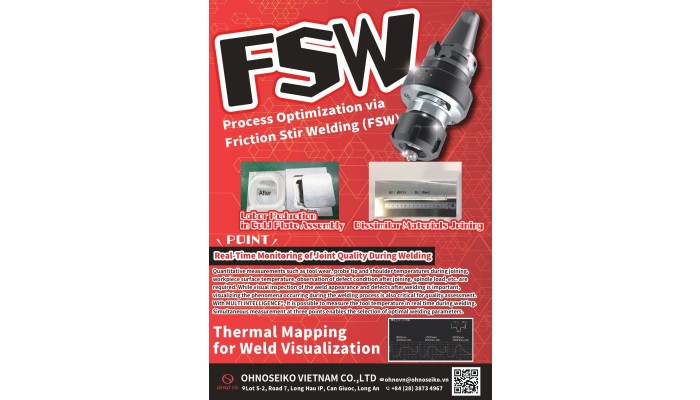
AI Data Centers are driving a shift from predominantly air-cooled systems to hybrid or Liquid Cooling architectures. Among these, Cold Plates are critical components for bringing coolant closer to GPUs, CPUs, and large heat sources.This change simultaneously opens up new requirements for Cold Plate manufacturing technology, from precision machining of Cooling Channels to Cover Plate joining, distortion control, and production process monitoring.With its CNC machining foundation and Friction Stir Welding (FSW) technology, Ohnoseiko Vietnam is developing capabilities with potential applications in thermal management products like Cold Plates. Notably, the approach combining FSW with real-time temperature and spindle load monitoring is a significant aspect of the company's research and optimization of welding conditions.Download Ohnoseiko Vietnam's FSW technology introduction document for details on principles, applications, and actual machining samples.
Company Information

Jigs and tools / Industrial machinery / Telecommunication equipment
Clamps - Base plate - Shaft
Machining high-precision single-piece parts with the motto Made in Japan at Vietnam. Processing different materials such as: metal, stainless steel, plastic, with high precision and can handle the sur ...
PICKUP
Technology & Services
CONTACT
Contact