


Ball Transfer FREEBEAR Y-type
Ball Transfer FREEBEAR Y-type is a flagship product within the group of ball transfer / multidirectional ball transfer / industrial ball transfer unit / material handling ball / conveyor ball / load transfer ball / omnidirectional transfer unit / multidirectional transport ball / industrial ball / load-bearing ball / workbench component / conveyor component / material handling support device / 360-degree swivel ball, researched, manufactured, and supplied by Freebear Corporation of Japan. This product group is used in activities such as sheet metal transfer, product rotation on workbenches, material redirection, jig and fixture positioning, carton movement, component feeding into machines, product assembly, visual inspection, packaging, blank feeding, and improving in-plant material handling systems.
Freebear Corporation is a Japanese company established in 1971, specializing in the development of ball transfers, Freebear Units, transfer tables, pneumatic lifting equipment, air die lifters, mold change carts, and heavy material handling systems in industrial manufacturing. FREEBEAR is the company's core brand, developed based on the principle of using a main load-bearing ball and multiple auxiliary balls to create rolling movement in all directions.
Within the company's product portfolio, FREEBEAR Y-type is one of the foundational ball transfer series with a wide range of applications. The product is designed for installation on workbenches, machine frames, inspection tables, packaging equipment, conveyor systems, automated machinery, or custom-built material handling structures. Multiple ball transfers can be arranged in rows, clusters, or spread across a tabletop to create a multidirectional transfer surface.
In modern industrial production, moving, rotating, and aligning products directly impacts operation time, labor productivity, safety, and the ability to maintain the quality of finished products. Items such as sheet metal, jigs, fixtures, component assemblies, cartons, or large-sized products are often difficult to change direction when placed on a fixed tabletop.
If operators have to drag objects directly on the table surface, products can incur scratches, deformation, impact damage, or be difficult to align precisely. Manually lifting products to rotate them also increases labor effort, extends cycle time, and can pose safety risks when objects are heavy or difficult to grip.
Traditional roller conveyors can reduce transport force but typically only allow objects to move in a specific direction. When needing to change direction left, right, rotate products, or align along multiple axes, companies must add separate redirection mechanisms, rotary tables, or lifting devices.
Therefore, the Ball Transfer FREEBEAR Y-type is a suitable solution for businesses that need to create a transfer surface allowing objects to move forward, backward, sideways, diagonally, or rotate 360 degrees. The product helps convert sliding friction into rolling friction, thereby reducing operational force and assisting operators in adjusting the object's position directly on the workbench.
Key Features of the Product
The strength of the Ball Transfer FREEBEAR Y-type lies in its multidirectional movement mechanism. The product uses a large main ball to directly contact the object being transported. Beneath the main ball are multiple auxiliary balls whose function is to support the load and transmit movement to the body.
When an object is pushed on the ball transfer surface, the main ball rotates in the direction of the object's movement. The auxiliary balls beneath simultaneously move, allowing the main ball to rotate in multiple directions instead of being limited to a fixed axis.
This structure allows operators to change the product's direction without lifting the object from the table surface. Objects can be pushed straight, pulled back, moved sideways, rotated around a center, or finely adjusted before being locked into the required position.
The FREEBEAR Y-type has a compact design and can be integrated into various types of equipment. Depending on the design, the ball transfer can be installed directly onto tabletops, steel frames, support plates, conveyor assemblies, or specialized material handling equipment.
Multiple units can be arranged in a grid pattern to form a ball transfer table. The spacing between positions must be determined according to the object's base dimensions, load capacity, product rigidity, and the flatness of the contact surface.
The Y-type series has been developed by Freebear Corporation with various models to meet requirements for load capacity, material, rust resistance, and product surface protection.
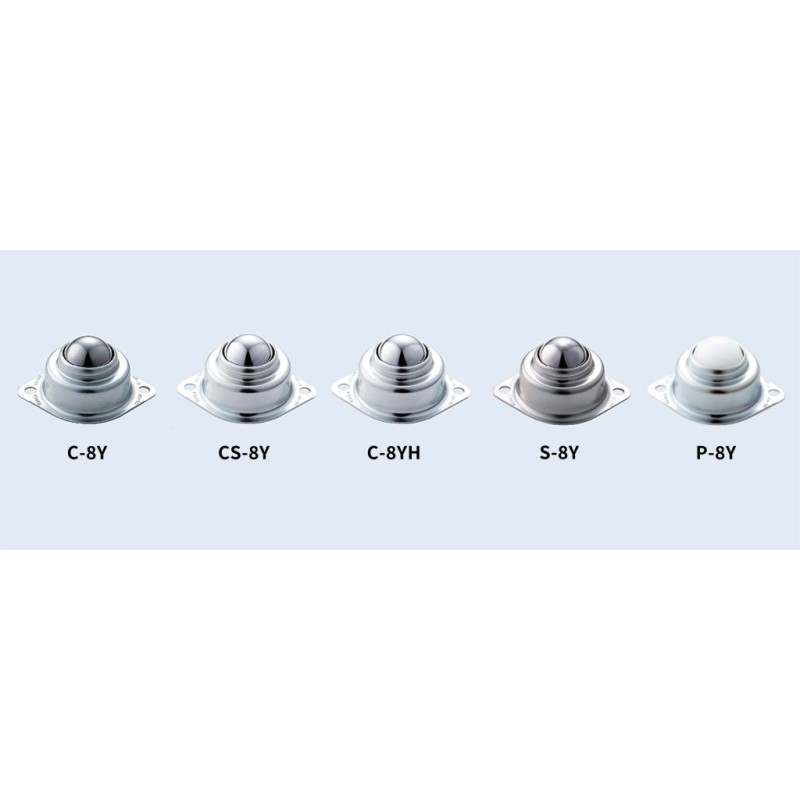
Model C-8Y is the standard version suitable for many common industrial applications. The product has an allowable load capacity of approximately 30 kg and a maximum load capacity of approximately 60 kg per ball transfer under manufacturer-specified conditions.
Model CS-8Y uses stainless steel main and auxiliary balls, combined with a steel body. This configuration is suitable for applications requiring improved rust resistance in the ball mechanism while maintaining a standard metal body structure. The allowable load capacity for this model is approximately 30 kg and the maximum load capacity is approximately 60 kg per unit.
Model C-8YH is a high-load capacity version, using a machined ball support to enhance load-bearing capability. The product has an allowable load capacity of approximately 80 kg and a maximum load capacity of approximately 160 kg per ball transfer, suitable for jigs, fixtures, sheet metal, and heavier component assemblies.
Model S-8Y uses a stainless steel construction, suitable for environments requiring rust resistance or higher material specifications compared to the standard steel version. The product has an allowable load capacity of approximately 30 kg and a maximum load capacity of approximately 60 kg per unit.
Model P-8Y uses a nylon plastic main ball, suitable for products with surfaces that need protection from scratches or contact marks caused by metal balls. This version can be considered for painted sheets, plastic parts, finished products, decorative materials, and sensitive surfaces.
The variety of models ensures that customers do not have to use the same configuration for all applications. Businesses can choose the standard version for general workbenches, the stainless steel version for humid environments, the high-load version for heavy jigs, or the plastic ball version for products requiring surface protection.
The Ball Transfer FREEBEAR Y-type can be used independently or in combination with roller conveyors. Rollers are responsible for transporting products along the main line, while ball transfers are positioned at intersections, inspection stations, or redirection points to allow operators to rotate and change the object's direction.
The product can also be combined with stoppers, guide rails, sensors, cylinders, clamping mechanisms, or positioning devices. After the object is moved to the required position, a stopper or clamping mechanism should be used to hold the object stable before machining, assembly, or inspection.
An important point when using ball transfers is that the actual load is not always evenly distributed across all installed balls. If the object's base is curved, deformed, or has protruding ribs, only a few ball transfers may make contact and bear most of the load.
Therefore, the total load capacity of a table should not be simply determined by multiplying the load capacity of one ball transfer by the total number of units. The design must include a safety factor and consider cases where the load is concentrated at a few contact points.
What Industries is the Product Applied In?
Ball Transfer FREEBEAR Y-type is applied in many fields such as:
- Automotive and Automotive Components Industry: Used at assembly tables, inspection tables, areas for handling jigs, fixtures, sheet metal, interior assemblies, and components requiring rotation or alignment before assembly.
- Motorcycle Industry: Suitable for component assembly lines, inspection of sub-assemblies, tray transport, and handling mechanical parts.
- Metal Stamping Industry: Supports the movement of sheet metal, stamped blanks, jigs, tools, and component assemblies between preparation tables and production machines.
- Precision Machining Industry: Used to feed parts, fixtures, or component assemblies to machining, inspection, and assembly positions.
- Machine Tool Industry: Suitable for blank feeding tables, jig support tables, tool preparation areas, and material feeding systems for machines.
- Electronics Industry: Applied at assembly tables, inspection tables, repair stations, packaging areas, and product transport lines.
- Electrical Equipment Industry: Used for electrical cabinet enclosures, control panels, equipment assemblies, metal boxes, and products requiring rotation during assembly.
- Office Equipment Industry: Suitable for printers, photocopiers, scanners, and product assemblies requiring direction changes during assembly, inspection, or packaging.
- Machinery Manufacturing Industry: Used in machine assembly tables, mechanical assembly adjustment tables, functional testing areas, and product finishing stages.
- Automation Industry: Can be integrated into assembly machines, inspection machines, blank feeding equipment, and material handling systems.
- Packaging Industry: Supports carton rotation, product redirection, labeling, visual inspection, and transfer of goods between stages.
- Intra-logistics Industry: Suitable for sorting tables, intersections between transport lines, sorting areas, and goods handling stations.
- Sheet Metal Processing Industry: Supports the movement of steel, aluminum, stainless steel sheets, or plate-shaped materials on machine tables and preparation tables.
- Plastics Industry: The version using a nylon main ball can be considered for products requiring reduced scratches or contact marks on the surface.
- Glass and Finishing Materials Industry: Can be used with appropriate configurations after evaluating load capacity, ball material, surface sensitivity, and safety requirements.
- OEM Manufacturing Industry: Suitable for businesses needing to integrate ball transfers into custom-designed tables, machines, or production lines.
- Machine Builders and System Integrators: Used as components in material handling equipment, inspection machines, packaging machines, assembly tables, and automation systems.
- FDI Enterprises and B2B Supply Chains: Suitable for factories requiring multidirectional transport solutions with clear technical data, drawings, and models.
Product Technology and Usage Process
Ball Transfer FREEBEAR Y-type is typically selected, designed, and used according to processes such as:
- Process for identifying the object to be transported: Determine product type, dimensions, weight, shape, material, and surface condition.
- Process for evaluating the object's base: Check flatness, location of stiffening ribs, protrusions, holes, and contact capability with the ball transfer.
- Process for determining movement direction: Clarify whether the object needs to move in one direction, multiple directions, sideways, or rotate 360 degrees.
- Process for model selection: Determine whether to use C-8Y, CS-8Y, C-8YH, S-8Y, P-8Y, or another configuration based on load capacity and environment.
- Process for material selection: Consider steel, stainless steel, or nylon main balls based on rust resistance, cleanliness, and surface protection requirements.
- Process for load calculation: Determine total load, concentrated load, center of gravity, and the actual number of ball transfers in contact with the object.
- Process for ball transfer arrangement: Determine the spacing between units to ensure the object is always supported by an appropriate number of balls throughout its movement.
- Process for table surface design: Select material, thickness, and frame structure with sufficient rigidity to limit deflection or height deviation.
- Process for height determination: Ensure the main balls have uniform height to prevent some positions from bearing excessive load.
- Process for edge stop design: Add stopper bars or protective frames to prevent objects from falling off the transfer table.
- Process for adding locking mechanisms: Use stoppers, clamps, pins, or cylinders to hold the product in the working position.
- Process for prototype fabrication: Assemble a small unit for testing pushing force, stability, and object rotation capability.
- Process for load testing: Place the actual object or an equivalent load onto the system to evaluate deflection, rotation capability, and load distribution.
- Process for redirection testing: Test the ability to move forward, backward, sideways, diagonally, and rotate within the workspace.
- Process for surface evaluation: Check whether the ball causes scratches, dents, or marks on the object being transported.
- Process for safety evaluation: Check for risks of objects free-rolling, falling off the table, colliding with operators, or unintended movement.
- Process for installation: Secure the ball transfer with correct hole dimensions, height, and installation method according to technical drawings.
- Process for acceptance testing: Confirm load capacity, operating force, stability, movement direction, and locking function before commissioning.
- Process for periodic cleaning: Remove dust, metal chips, grease, and foreign objects that may obstruct ball movement.
- Process for maintenance inspection: Monitor rotation capability, play, noise, wear level, and the condition of the ball transfer body.
- Process for replacement: Replace jammed, deformed, or degraded ball transfers to prevent load concentration on remaining units.
The product is used in many activities such as:
- Multidirectional object transfer on workbenches.
- Product rotation for assembling different sides.
- Product redirection between two roller conveyor lines.
- Jig and fixture alignment before locking.
- Feeding sheet metal onto machine tables or processing areas.
- Visual inspection, where products need to be rotated for multi-sided observation.
- Packaging, labeling, and product finishing operations.
- Transferring cartons or component trays between stages.
- Feeding blanks to machines and automated equipment.
- Assembly of machine sub-assemblies, control panels, and industrial equipment.
- Workbench improvement activities to reduce dragging or lifting objects.
- Goods sorting activities at intersections within conveyor systems.
- Product position adjustment before dimension measurement or functional testing.
- New equipment development by machine builders and system integrators.
- Improvement of existing production lines without needing to replace the entire transport system.
- Reducing operational force for workers in assembly areas.
- Handling large-sized or difficult-to-grip products.
- Transporting products with finished surfaces using the appropriate plastic ball version.
- Designing custom-sized ball transfer tables.
- Mass production activities requiring reduced product transfer and rotation time.
The Ball Transfer FREEBEAR Y-type must be selected based on the specific technical conditions of each application. Businesses need to clearly define the object's load capacity, base dimensions, flatness, center of gravity, movement direction, operating speed, environmental conditions, and surface protection requirements.
Subsequently, businesses select the model based on load capacity and material. C-8Y may be suitable for common industrial applications; CS-8Y is suitable when stainless steel balls are required; C-8YH is suitable for higher load capacities; S-8Y is suitable for applications requiring stainless steel construction; P-8Y is suitable for surfaces needing scratch limitation.
The number of ball transfers must be calculated based on the actual load impacting each position. In reality, the object's base may not simultaneously contact all ball transfers. Therefore, the design must include a safety factor and should assume the load is concentrated on fewer balls than the total number of units installed.
The arrangement spacing must ensure the object does not tilt, fall through, or become unstable during movement. Objects with small bases require shorter ball transfer spacing compared to objects with large and rigid bases.
Ball transfers must be installed on a frame or tabletop with appropriate rigidity. If the mounting surface sags, the height of the balls will be uneven, leading to some positions bearing excessive load and reducing operational capability.
After an object is moved to the working position, a stopping or locking mechanism is required. Because ball transfers reduce resistance, the object may continue to drift if the table is tilted, impacted, or subjected to unintended forces.
For objects with easily scratched surfaces, businesses should test the nylon ball model on actual samples. Surface protection capability depends on the material, load per point, cleanliness of the ball, and the presence of chips or hard particles.
Businesses also need to maintain cleanliness in the usage area. Metal chips, dust, and foreign objects can adhere to the ball or enter the ball support mechanism, increasing resistance and creating scratches on the product.
Structure and Main Components of the Product
Ball Transfer FREEBEAR Y-type is typically evaluated through its main components and factors such as:
- Main ball: The component that directly contacts the object to be transported and bears the load from the product.
- Auxiliary ball system: Consists of multiple small balls that support the main ball and transmit movement to the body.
- Ball support: Responsible for maintaining the position of the ball system and directly affecting the smoothness of movement.
- Ball transfer body: The structure enclosing the ball mechanism and connecting the product to the tabletop or equipment.
- Main ball material: Can be steel, stainless steel, or nylon depending on the model and usage requirements.
- Auxiliary ball material: Selected according to product configuration, load capacity, and environmental conditions.
- Body material: Can be steel or stainless steel depending on the model.
- Mounting section: The area that helps secure the ball transfer to the table, machine frame, or equipment assembly.
- Ball height: Determines the height of the transfer surface and needs to be uniformly controlled across all positions.
- Main ball diameter: Affects contact capability, rolling smoothness, and the overall dimensions of the product.
- Allowable load capacity: The recommended load level for stable operation under manufacturer's conditions.
- Maximum load capacity: A higher load limit that should not be used as a continuous operating load.
- Multidirectional rotation capability: Allows the main ball to change its direction of movement according to the force applied to the object.
- Rust resistance: Depends on the ball and body materials, and the usage conditions of each model.
- Surface protection capability: Depends on the main ball material, point load, and cleanliness level of the system.
- Installation accuracy: Affects the ability to evenly distribute load across the entire table.
- Support frame: Not a direct component of the ball transfer but determines the rigidity and stability of the system.
- Stopping mechanism: Integrated externally to prevent unintended object movement.
- Guide rails: Support controlling the range or direction of movement when the application does not require complete freedom.
- Traceability information: Includes model, material, load specifications, drawings, and technical data of the product.
Depending on their needs, businesses can choose different models regarding material, load capacity, and contact characteristics. Selecting the correct configuration helps balance movement force, rust resistance, surface protection, durability, and investment costs.
Benefits for Businesses and Factories
Using the Ball Transfer FREEBEAR Y-type helps businesses reduce the force required to move products on workbenches. Operators can push, pull, rotate, or align objects without having to lift the entire product weight.
The product helps improve ergonomics in the workplace. By reducing lifting and dragging operations on fixed surfaces, businesses can limit labor effort and create more convenient operating conditions for employees.
The FREEBEAR Y-type helps shorten cycle times. Products can be rotated directly at the assembly or inspection station, instead of requiring lifting equipment or transfer to a separate rotary table.
For assembly tables, ball transfers help operators access multiple sides of a product. This is suitable for machine sub-assemblies, equipment enclosures, control panels, and products requiring component installation from various sides.
For inspection tables, the product helps adjust objects to measurement positions or rotate products for visual inspection. Moving in small increments also aids in alignment with fixtures and measuring equipment.
For packaging stages, ball transfers help rotate cartons or products for labeling, material wrapping, inspection, and packaging without manual lifting.
For conveyor systems, the FREEBEAR Y-type creates flexible redirection points. Products can be arranged at intersections of multiple lines to support transferring goods left, right, or rotating them in a new direction.
For machine builders, ball transfers are components that can be integrated into various designs. Engineers can use the product for blank feeding tables, inspection tables, packaging machines, assembly equipment, or custom material handling systems.
For production departments, the product helps improve existing production lines without necessarily investing in fully automated systems. A suitably designed ball transfer table can directly solve the problem of rotating and redirecting objects at a workstation.
For quality departments, reducing product dragging on the table surface can help limit external damage. The nylon ball version also provides an additional option for objects with sensitive surfaces.
For maintenance departments, the modular structure allows individual ball transfers to be inspected and replaced when necessary. Businesses do not have to replace the entire table if only a few positions are worn or jammed.
For procurement departments, the clear model catalog helps in selecting products based on load capacity, material, and usage environment. Businesses can standardize certain models for multiple tables or equipment within the same factory.
The Ball Transfer FREEBEAR Y-type also helps businesses utilize production space efficiently. Its multidirectional movement capability allows for more flexible design of tables and transport lines in areas with limited space.
However, the product's effectiveness depends on correct selection and installation. Businesses need to calculate load capacity, number of ball transfers, arrangement spacing, table surface rigidity, and safe stopping mechanisms before putting the system into operation.
The Ball Transfer FREEBEAR Y-type is a suitable choice for automotive, motorcycle, electronics, electrical equipment, precision machining, machine tool, metal processing, packaging, intra-logistics, machine building, and automation businesses that need to improve material handling, rotation, and positioning on work surfaces.
With many typical models such as C-8Y, CS-8Y, C-8YH, S-8Y, and P-8Y, the product can meet requirements ranging from common industrial applications to high load capacity, rust resistance, or surface scratch prevention. Its multidirectional movement capability helps businesses reduce operational force, shorten redirection times, improve workbench flexibility, and enhance production efficiency in modern factories.
Jigs / Manufacturing facilities / Construction machinery parts
CONTACT
Inquiry for the above productCompany Information
Multi-directional ball transfer unit / Mold Change Assist Equipment / Pneumatic equipment
Freebear Corporation, with its Japanese name 株式会社フリーベアコーポレーション, is a Japanese company specializing in the development, manufacturing, and supply of ball transfers, multi-directional transport equipmen ...
Related Technologies/Services
-
 Ohnoseiko Vietnam opens seco ...
Ohnoseiko Viet Nam co.ltd
-
 Precision Machining for Alum ...
Prec Co.,ltd
-
 Japanese Quality Mold Manufa ...
CNC TECHNOLOGY SOLUTIONS JOINT ...
-
 Heat treatment and cam angle ...
Ohashi Tekko Vietnam Inc.
-
 Lathe Machining for Shaft Co ...
YAMAGUCHI VIETNAM JSC
-
 OEM Vietnam | Assembly and r ...
LEO ELECTRONICS (VIETNAM) Ltd