


When to use ASRS for food warehouses? 7 signs that it's time for businesses to automate their warehouse
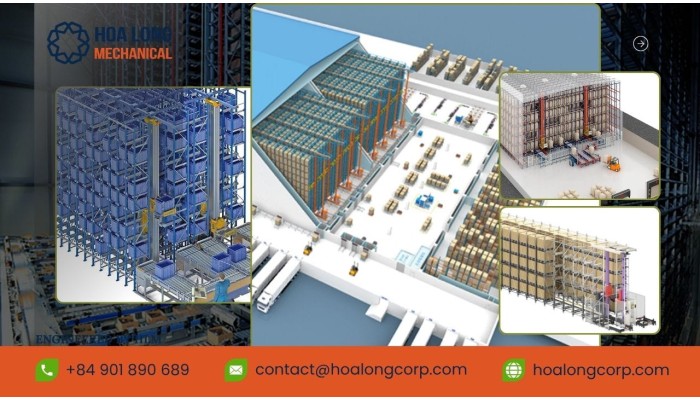
Discover exactly when F&B businesses should invest in ASRS food warehouse systems. Analyze ROI, optimize deep-freeze cold storage, and Smart Warehouse solutions from HLM experts.
Is ASRS a trend or has it become a standard?
If a decade ago, ASRS (Automated Storage and Retrieval System) was considered a "luxury item" found only in multinational logistics centers and mega-segment FDI factory complexes, by 2026, the landscape of space and operational challenges in Vietnam has completely changed.
The surge in unskilled labor costs, the increasing scarcity of industrial land in key economic regions (such as Binh Duong, Dong Nai, Long An, Bac Ninh...), coupled with stringent technical barriers for traceability from international markets, have pushed the F&B industry into a corner: Automate or be eliminated. The Smart Warehouse model is no longer a story of the future; it is a vital standard in the present.
At this point, the core critical question for Factory Directors or Logistics Managers is no longer: "Is the ASRS system good?" The precise strategic question must be: "Based on which actual operational indicators can I confirm that my food warehouse has reached the mandatory investment point for ASRS?"
What is ASRS? Defining its essence from a warehousing technical perspective
To avoid common misunderstandings when evaluating the solution, businesses need to understand its essence: ASRS (Automated Storage and Retrieval System) is a fully automated or semi-automated pallet storage and retrieval ecosystem, operating based on absolute synchronization between high-precision mechanical hardware and intelligent control software.
A standard automated pallet storage system consists of 3 foundational layers:
Hardware & Robotics Layer: Includes Robot Stacker Crane, Robot Shuttle systems (operating multi-directionally or uni-directionally within the rack), Conveyor System, optical sensors, laser positioning, Barcode scanning technology, and RFID chips.
Software Control Layer (WCS – Warehouse Control System): Responsible for commanding and coordinating the physical movement flow of robot arms and Stacker Cranes, ensuring devices do not conflict paths and achieve the shortest loading/unloading cycle.
Central Management Layer (WMS – Warehouse Management System): The brain that manages all inventory data, lot locations, and real-time date management.
Instead of relying on the movement and speed of human-operated forklifts, this robotics warehouse system automates 100% of the process: Receives commands from ERP/WMS → Locates pallet coordinates → Executes coded movements → Stores/Retrieves goods with near-zero positional error.
Why is the food industry one of the fastest to adopt ASRS?
The food and beverage (F&B) industry has extremely stringent characteristics that sectors like mechanical engineering, textiles, or fast-moving consumer goods typically never face. The F&B supply chain is constantly besieged by pressure to manage expiry dates, strictly control cross-contamination risks according to HACCP and ISO 22000 standards, and especially the pressure to conserve energy in deep-freeze cold storage.
Hoa Long Mechanical constructs and installs cold storage racking systems
Hoa Long Mechanical constructs and installs cold storage racking systems
When implementing warehouse automation, ASRS simultaneously resolves these "bottlenecks" by completely eliminating delays in the loading/unloading phase, compressing storage density to the maximum, saving up to 50% of refrigeration electricity, and entirely removing subjective human error in inventory rotation. This is why, during the 2025-2026 period, new-generation food factory investors always integrate automated warehouse solutions right from the feasibility study phase.
7 Signs It's Time to Invest in an ASRS Food Warehouse
To determine whether your business should stop using traditional static racking systems and transition to an ASRS food warehouse, directly compare it with the 7 technical signs below:
1. Storage capacity exceeds 5,000 pallets and complex SKU catalog
When food warehouse capacity reaches or exceeds 5,000 food pallets, management by human labor and conventional forklifts begins to reveal performance saturation gaps. Forklift drivers taking 5-7 minutes just to find a pallet location or picking the wrong outgoing lot occurs with increasing frequency. ASRS controls all warehouse coordinates via a digital matrix, reducing location information retrieval speed to under 1 second and providing real-time inventory status updates for the production planning department.
2. Labor costs are too high and staff turnover is significant
A traditional food warehouse operating 3 continuous shifts requires a huge workforce: from heavy-duty certified forklift drivers, scanning personnel, inventory control staff, to safety supervisors. Recruitment, training, and new insurance costs are projected to increase sharply in 2026, along with the risk of operational disruption when personnel suddenly leave. With ASRS, the number of direct laborers in the storage area decreases by up to 80%, requiring only a few system operation engineers in the central control room.
3. Cold storage operating costs account for too large a proportion of revenue
For frozen food warehouses (meat, seafood, export agricultural products), the energy cost to run refrigeration compressors is the most challenging problem. In traditional warehouses, continuous forklift entry and exit lead to massive heat loss through warehouse doors (Dock Leveler/Door), while Selective racking systems require too much space for forklift aisles (3.2m – 3.8m wide), resulting in businesses paying electricity to cool "excess empty space."
Popular cold storage racking systems
HLM cold storage racking systems
ASRS eliminates all forklift aisles, minimizing the volume requiring refrigeration. Robots operate entirely in sealed deep-freeze environments down to -25°C without continuous door opening, immediately cutting electricity costs by 30% – 40%.
4. Inbound goods frequency reaches overload status
If your food warehouse has to continuously process hundreds to thousands of pallets daily, traditional forklifts will create a "bottleneck" phenomenon at the receiving/shipping dock area. Forklift drivers must move constantly, creating psychological pressure and leading to a decrease in speed towards the end of the shift. Robot Stacker Cranes and conveyors in an ASRS system operate at a constant speed 24/7, increasing the inbound/outbound cycle time by 3 – 4 times compared to manual methods.
5. Loss rates due to incorrect lots or expiry dates still occur
In the F&B industry, shipping an incorrect lot near its expiry date or distributing a faulty product lot is a brand disaster and incurs compensation costs. Despite strict procedures, humans still have a margin of error when visually recording. An automated storage system tightly integrates FIFO (First-In, First-Out) or FEFO (First-Expired, First-Out) logic into its hardware: The system will lock and not allow picking pallets that are not yet due for retrieval, eliminating 100% of the risk of goods being discarded due to expiration.
6. Limited warehouse land area but need to double capacity
If a business wants to expand warehouse capacity but there is no land available around the factory for horizontal expansion, the only solution is to build upwards. Conventional heavy-duty forklifts can only lift to a maximum height of 11m – 12m (with Selective racking) or 15m (with VNA racking). In contrast, an ASRS Stacker Crane can easily reach heights of 20m, 30m, or even 40m. This increases storage density per square meter of floor space by 300% compared to conventional warehouses, saving millions of USD in new industrial land acquisition costs.
7. Strategic direction shifts towards Smart Factory
When a business is digitizing its entire factory with core resource management systems like ERP (SAP/Oracle) and MES (Manufacturing Execution System), the warehouse cannot be a separate "data dark zone." ASRS acts as the central piece of the Smart Warehouse, directly connecting the data flow from raw material inbound to production lines, all the way to packaged finished goods through standardized API communication ports, creating an absolutely seamless supply chain.
Actual operating principle of an ASRS food warehouse system
To visualize it, the entire movement lifecycle of a food pallet within an ASRS system is established according to a fully automated closed-loop process as follows:
Finished goods from the Production line
↓
Automated Conveyor system moves to the control station
↓
Optical sensors & Barcode/RFID scanners automatically read lot data
↓
WMS software cross-references, checks dimensions/safe load, and assigns storage coordinates
↓
WCS software system directs Robot Stacker Crane/Shuttle to receive the pallet
↓
Robot automatically moves along high-speed X-Y-Z axes, placing the pallet precisely into the designated rack slot
↓
[Upon receiving an outbound order from ERP] ↓
Robot Stacker Crane automatically picks the correct pallet according to FEFO/FIFO principles and brings it to the end of the lane
↓
Conveyor system transfers pallets to the outbound dock area and sorts them by truck
The entire sequence of actions above occurs with linear automation, completely eliminating direct human and forklift intervention within the warehouse.
Technical comparison table: ASRS vs. other racking systems
To help businesses accurately position ASRS's technical standing within current storage solutions, let's analyze the in-depth comparison table below:
Comparison Criteria Selective Racking Drive-In Racking Shuttle Racking System ASRS Automated Warehouse System
Level of Automation Low (100% Manual) Low (100% Manual) Medium (Semi-automated) Very High (Fully Automated)
Core Operating Equipment Standard reach forklift Forklift operating deep inside the rack Robot Shuttle + Supporting forklift Robot Stacker Crane / Multi-Shuttle / Conveyor
Software Requirements Not mandatory (Can use Excel) Not mandatory Basic WMS needed Mandatory integration of WMS & WCS duo
Throughput / Inbound-Outbound Speed Medium Low High Very High (Continuous 24/7 operation)
Positional & Lot Error Rate Medium (Driver-dependent) Medium (Driver-dependent) Low Near 0% (Eliminates human error)
Maximum Exploitable Height 11m – 12m 11m – 12m 15m – 18m From 20m – 40m
Required Forklift Aisle Area Very wide (3.2m – 3.8m) Wide (3.0m – 3.2m) Medium (3.2m at the aisle end) No forklift aisle needed
Safety for Racking Structure Medium risk of forklift collision Very high risk of collision due to forklift entering the rack Low (Forklift only operates at the rack end) Absolutely safe (No forklift inside the rack)
Smart Warehouse Compatibility Poor Poor Good Excellent (Is the core of Smart Warehouse)
Is ASRS a "master key" for all food warehouses?
The straightforward answer from HLM experts is: No. ASRS only maximizes its economic and technological power when placed in the right operational ecosystem. Investing in ASRS impulsively without thoroughly analyzing throughput data will lead to serious capital waste.
Businesses SHOULD invest in ASRS when:
• Large storage scale (Typically over 3,000 – 5,000 pallets).
• Warehouse operates continuously for 2 to 3 shifts/day, with uninterrupted goods flow.
• Central Distribution Center or finished goods warehouse directly connected to a large-scale manufacturing plant.
• Deep-freeze cold storage facilities with extremely high electricity costs.
Businesses SHOULD NOT yet invest in ASRS when:
• Small warehouse scale under 1,000 pallets.
• Initial investment budget is strictly limited.
• Low inbound/outbound frequency (goods stored statically for too long).
• Too few SKUs and products without stringent expiry date management requirements.
In these medium and small-scale warehouse cases, choosing solutions like Selective Racking, Drive-In Racking, or upgrading to a semi-automated Radio Shuttle Rack system combined with galvanized steel pallets will yield a much more optimal and realistic Return on Investment (ROI).
HLM's Perspective: The essence of ASRS ROI is not in labor cost reduction
Advice from Hoa Long Mechanical (HLM):
"Most businesses, when calculating the ROI for an ASRS project, make a common mistake: They only take the total salary savings from reduced labor and divide it by the initial investment cost of the robotic system. This calculation method is entirely one-sided and inadvertently prolongs the payback period on paper."
"In the F&B industry, the true value that generates the largest cash flow for businesses when operating ASRS lies in the 'hidden costs' that are eliminated: This includes completely eradicating the rate of goods spoilage due to expired dates (reducing losses by billions of VND annually); directly cutting cold storage electricity bills by 30%; increasing delivery speed to release trucks faster, boosting the working capital turnover of the entire business; and above all, the ability to protect brand reputation against stringent quality inspections from international partners thanks to transparent data systems."
2026 Trend: The Rise of AI-Powered Smart Warehouses in the F&B Industry
By 2026, automated storage system technology will no longer be mindless mechanical machines moving according to fixed programs. The current breakthrough trend is the deep integration of AI (Artificial Intelligence), Robotics, and Digital Twin technology to create AI-powered Smart Warehouse systems.
In this system, AI algorithms will continuously analyze historical inbound/outbound data, forecast seasonal consumption trends, and then automatically command robots to relocate and rearrange SKU positions in the warehouse during off-peak hours (night). Fast-moving SKUs will be automatically moved to lower rack levels and closest to the outbound aisle, while slower-moving items will be pushed further back.
Simultaneously, the rise of new-generation AMR (Autonomous Mobile Robot) and AGV (Automated Guided Vehicle) robots, combined with AI-powered camera systems (Computer Vision), helps warehouses automatically detect and handle issues like damaged pallets or torn packaging during movement without needing to halt the entire system.
Checklist: Is your food warehouse ready for ASRS?
Check the criteria below to assess your business's readiness:
• Current or planned 5-year capacity exceeds 5,000 pallets.
• Warehouse operational staff turnover or shortage rate (especially cold storage forklift drivers) exceeds 20%/year.
• Operating costs and refrigeration system electricity costs are growing beyond control.
• The business aims to build a high-bay warehouse (over 20m) to save land area.
• The factory has implemented or is in the process of implementing an ERP system (SAP, Oracle, Microsoft Dynamics…).
• The business is required to strictly comply with FEFO/FIFO standards for high-end export markets (USA, Europe, Japan).
• Inbound/outbound frequency is continuous, and traditional forklifts frequently experience congestion at the dock.
• The business has a stable vision and development strategy for the next 10 – 15 years.
Result: If your business checks 5 or more criteria, establishing a feasibility study report and in-depth technical survey for an ASRS system is a mandatory step right now to preserve competitive advantage.
Conclusion
ASRS food warehouse systems are no longer the exclusive domain of global giants. In the context of the 2026 logistics economy demanding lean operations, maximum precision, and ultra-fast response times, ASRS is the launchpad that helps Vietnamese F&B businesses standardize core operational capabilities. However, warehouse automation is a long-term investment journey, requiring a deep understanding of load-bearing mechanical architecture, physical movement flow, and information technology infrastructure.
Hoa Long Mechanical's (HLM) team of technical experts and supply chain solution engineers is always ready to accompany businesses:
🎁 100% Free: On-site survey services, throughput data measurement, and 3D layout simulation for space optimization.
📈 Transparent ROI analysis: Detailed calculation of return on investment, CAPEX/OPEX estimation based on the business's financial capacity and actual SKU characteristics.
🛠 Comprehensive integration roadmap: Designing ultra-high heavy-duty steel racking systems perfectly compatible with Robot Stacker Crane, Shuttle, Conveyor, and standardizing connections with the business's WMS/WCS software, committed to strictly meeting international load-bearing standards and the latest fire prevention and fighting standard TCVN 14496:2025.
HOA LONG MECHANICAL MANUFACTURING JOINT STOCK COMPANY
Hotline: 0901 890 689
Email: contact@hoalongcorp.com
Website: www.hoalongcorp.com
Engineered by HLM – Built for Real Warehouses
_thumb_ec951577-cca2-449a-96c5-cace09ba405f.jpg)
