
NC Network Vietnam JSC
PRODUCT
Production Goods
What is Business Matching? A Solution for Connecting Buyers and Suppliers for Manufacturing Businesses

If customers have ever attended an industrial exhibition, they will surely understand the feeling: crowded booths, many business cards collected, but once back at the office… they don't know who is who, what the specific needs are, and what the next step is. Business Matching was created to solve that problem. Instead of letting "fate" lead the way, this activity organizes connections based on the demand data and supply capabilities of each business, from before the meeting until the implementation steps are agreed upon. Are businesses looking to optimize time and improve the quality of connections between manufacturing businesses and buyers/suppliers? Business Matching is the "purposeful bridge," helping businesses meet the right, suitable partners with real needs, enhancing the effectiveness of meetings, and avoiding wasted time!
1. What is Business Matching?

In practice, Business Matching is often operated as a standardized process: demand collection – screening – proposal – scheduling – 1:1 meetings – post-connection follow-up. It's like not just "going to the market" but also having a clear shopping list, budget, technical standards, and cooperation conditions.
Whether implemented in the context of exhibitions, conferences, or online B2B platforms, the core spirit remains the same: connecting the right people – with the right needs – at the right time.
1.1 Definition of business matching
Essentially, Business Matching is a structured commercial networking activity between businesses to create suitable trade opportunities, based on the demand information and capability profiles of each party.
Instead of letting parties find each other through "free networking," Business Matching uses processes and filters to increase the probability of success from the outset. Businesses not only present "what we have," but also clearly demonstrate "what we need" and "what we can do according to what standards."
To put it simply: if Networking is often "meeting to get to know each other," then Business Matching is "meeting to discuss specific business and move towards an agreement."
1.2 Objectives of business matching
The objective of Business Matching goes beyond creating conversations — it's about generating business results. Specifically, it aims to:
- Find the right partners who meet technical standards, deadlines, production capacity, and supply capabilities.
- Shorten the search and screening lifecycle (search → shortlist → meeting → follow-up).
- Increase the conversion rate from "initial contact" to "commercial negotiation."
- Ensure meetings have a clear context: what problem, what standard, what conditions, what timeline.
Based on many years of practical implementation experience with businesses by NC Network Vietnam, many businesses fail to convert "contacts" into "deals" not because of a lack of opportunities, but because of a lack of structure for the discussion. Business Matching acts as a "framework" that helps parties get straight to the point.
2. Why is Business Matching Important for Manufacturing Businesses?
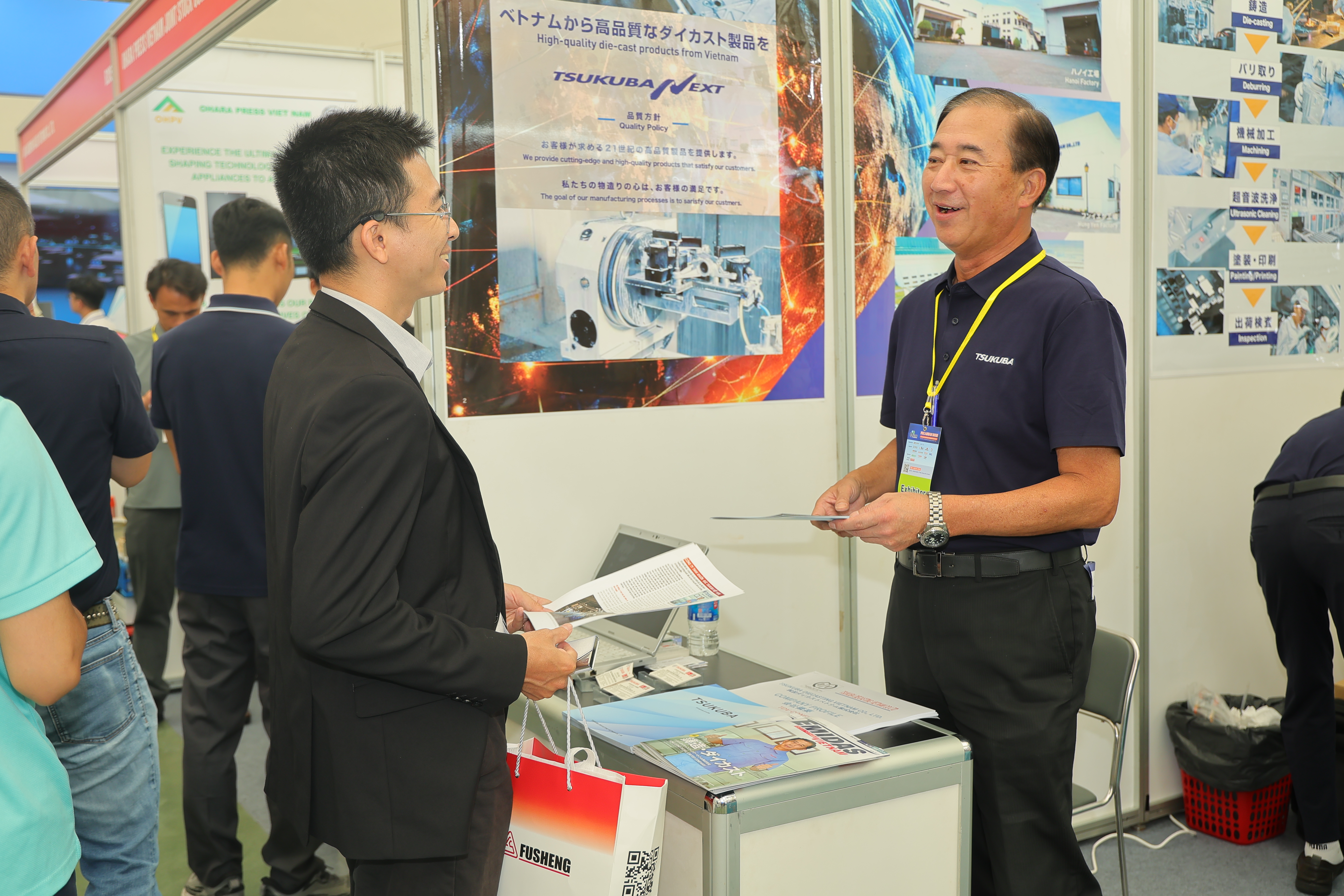
In the manufacturing industry, everything has "weight" and "constraints": from tolerances, materials, quality control processes to on-time delivery capabilities. Therefore, finding partners cannot rely entirely on intuition or personal relationships.
Business Matching is important because it transforms partner search into a logical process, reducing reliance on luck. This is also why many businesses use Business Matching as a "strategic channel" in their market development plans.
The best aspect of Business Matching is that it helps manufacturing businesses "speak the language of manufacturing" from the outset: standards, capabilities, productivity, inspection capabilities, and batch fulfillment capacity.
2.1 Helps businesses find the right partners instead of random encounters
Traditional networking might lead businesses to meet the right partners... by luck. But in an environment with too many suppliers and too many potential buyers, luck cannot be a strategy.
Business Matching helps reduce noise by arranging meetings based on:
- Specific buyer needs (products, materials, quantity, standards…)
- Supplier capabilities (production lines, certifications, scale, customization capabilities…)
- Industry sector and scope of cooperation (OEM/ODM, contract manufacturing, supporting industries…)
This is particularly important for manufacturing businesses because "right" doesn't just mean being in the same industry, but also having the correct actual operational capabilities. For example, a supplier might be able to produce a product, but cannot meet accuracy requirements, or lacks the capability for rapid prototyping. Business Matching allows for pre-screening of such barriers.
2.2 Shortens the time for searching buyers and suppliers
In reality, time is money. A buyer spends weeks reviewing suppliers, requesting quotes, and comparing standards. A supplier also spends time finding suitable buyers, answering many "just asking" emails, and then silence.
Business Matching shortens the loop by pre-organizing:
- A list of suitable businesses
- Discussion topics
- Targeted 1:1 meeting schedules
Simply having a specific meeting schedule and a clear agenda significantly saves resources for both parties. Business Matching is like going straight to a "purposeful appointment," instead of wandering around "looking for the way."
2.3 Increases connection efficiency at exhibitions and B2B events
Industrial exhibitions can be very effective for brand recognition, but if the goal is to find partners for signing contracts, a connection mechanism is needed.
Business Matching acts as an "accelerator" for B2B exhibitions/events. Instead of just standing at the booth waiting for people to ask, one can:
- Proactively meet the right people from the pre-screened list
- Expedite the technical information exchange process
- Transition discussions to the follow-up stage immediately after the event
In some cases, Business Matching also helps businesses create a series of consecutive meetings within a short period, maximizing the resources of both parties.
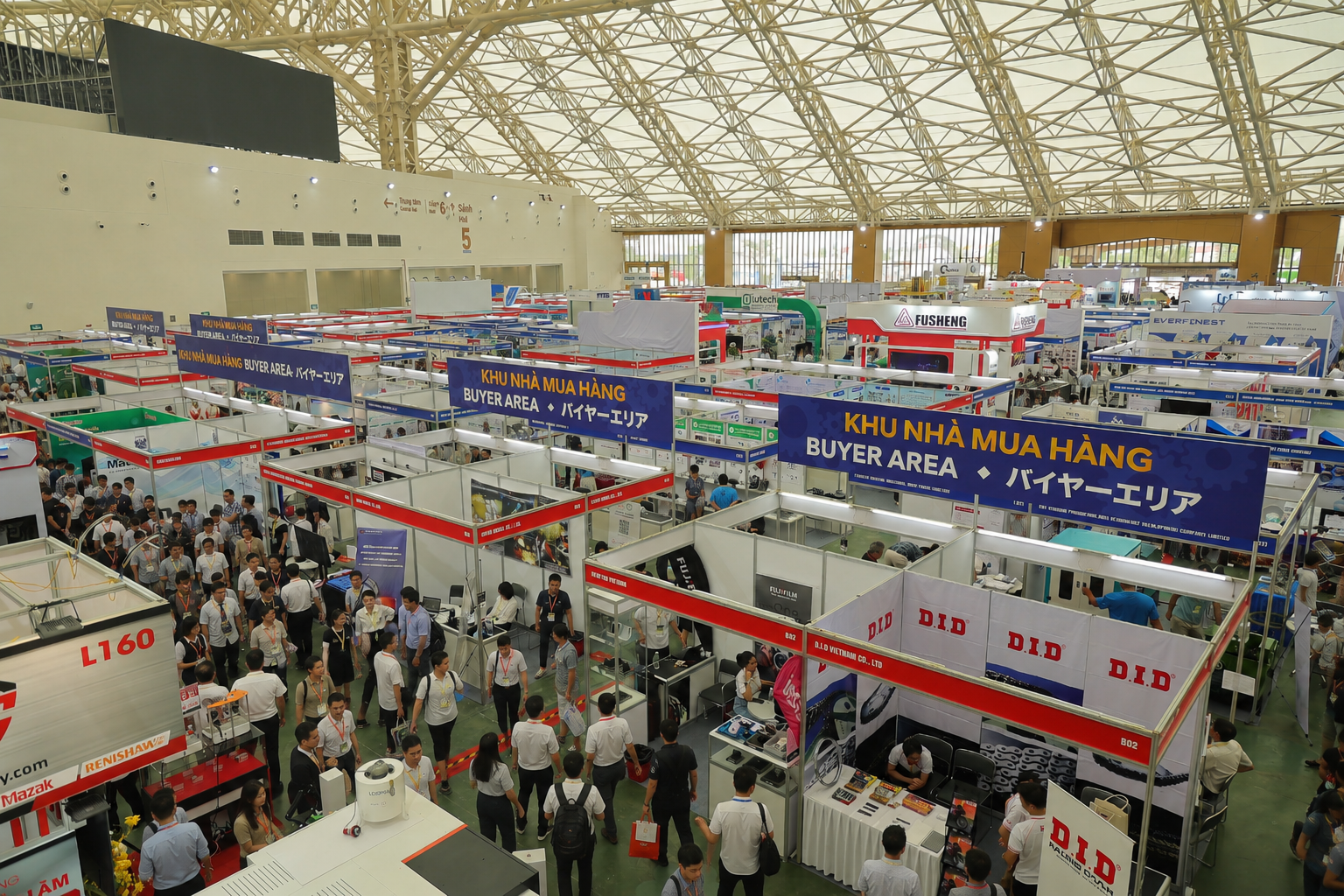
In fact, the FBC ASEAN exhibition organized by NC Network Vietnam is also implementing Business Matching activities. Instead of spending a lot of time visiting, searching, and meeting each booth individually with limited effectiveness, visitors are encouraged to pre-register information about their field of activity and actual needs. Based on this data, the NC Network Vietnam team will research, screen, and propose a list of suitable businesses, helping exhibition visitors meet the right partners, save time and costs, and enhance the effectiveness of their exchanges.
2.4 Suitable for businesses looking to expand into new markets
Businesses looking to expand into new markets (e.g., from Vietnam to Japan, the EU, or vice versa) often face two challenges: finding the right channels and building trust quickly.
Business Matching addresses both aspects:
- Channel: filtered connections, targeting the right business groups
- Trust: meetings with specific content, related to production standards and cooperation conditions
This is why many businesses view Business Matching as an "input" for their export strategy. It helps businesses have the opportunity to discuss requirements directly instead of just sending catalogs and waiting for vague responses.
3. How Does Business Matching Work?
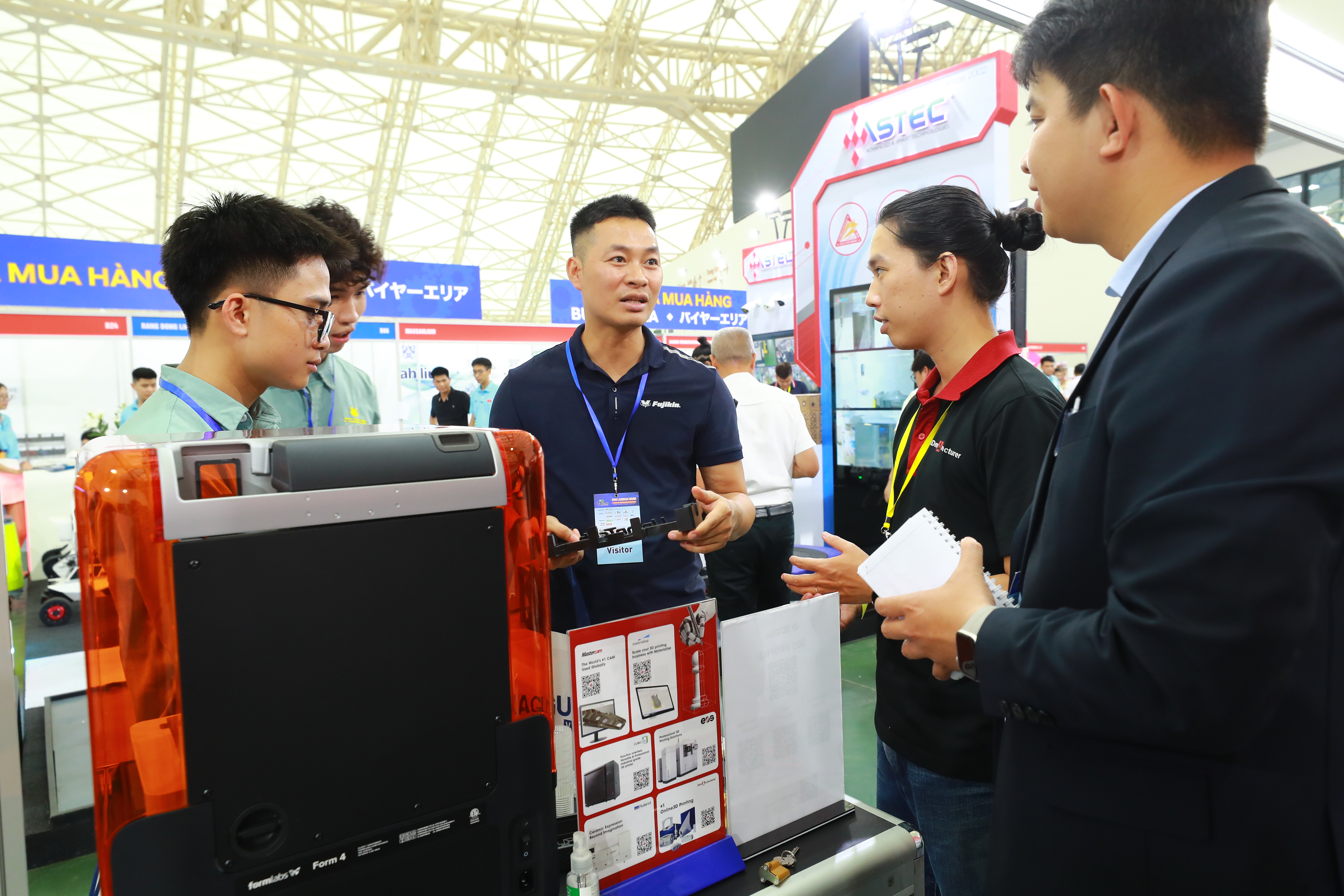
If Business Matching is envisioned as a series of steps, it becomes clear it's not "vague." The organizer (or platform) typically operates according to a clear workflow to ensure high-quality meetings.
To be effective, a Business Matching program requires clean input data, a reasonable screening process, and a follow-up mechanism. Below is a common model used by many B2B events, divided into 5 steps following the logic from needs to results.
3.1 Step 1 – Business Needs Collection
This stage is foundational. Businesses provide information about:
- Who you are in the supply chain (buyer, supplier, OEM/ODM…)
- What products/services you need (specs, standards, estimated quantity…)
- What capability requirements you have (lead time, customization ability, certifications…)
- What cooperation model you prefer (contract manufacturing, long-term purchasing, sample orders…)
The important point is: the more "actionable" the need, the more effective the connection. If you simply state "need to find a mechanical supplier," you will get many meetings, but the quality might not be as expected. Conversely, if you specify "CNC machining of 316 stainless steel, tolerance ±0.01mm, batch of 2,000-5,000 pcs/month," you will filter for the right group.
3.2 Step 2 – Partner Profile Analysis and Screening
After data collection, the organizer or system will cross-reference between:
- Buyer's needs with supplier's capabilities
- Industry sector and technical suitability
- Ability to meet timelines, scale, and cooperation methods
At this step, the filter helps reduce the risk of "meeting the wrong person." Therefore, input data plays a decisive role. Good Business Matching is like a "matching system": the clearer the criteria, the higher the quality of the match.
3.3 Step 3 – Proposing a List of Suitable Partners
Once screened, the organizing party will propose a list of partners. Businesses can:
- Confirm their level of interest
- Add technical information to increase accuracy
- Adjust criteria if not yet suitable
During this stage, businesses should actively review the match list as a potential "pipeline." Each meeting should have an objective: do you want to get samples? Do you want a quote? Do you want to confirm capabilities?
3.4 Step 4 – Arranging 1:1 Meetings
This is the "key" part. 1:1 meetings typically include:
- Timeframe (e.g., 20–30 minutes)
- Agenda or discussion objectives (according to match profile)
- Pre-prepared information (depending on the event)
Scheduling helps avoid the situation of "discussing only upon arrival." Necessary documents can be prepared: specification sheets, technical requirements, product catalogs, case studies…
Businesses should prepare a "short script" for the meeting: 3–5 points to confirm, 1–2 important questions, and expected next steps (send RFQ, samples, factory audit…).
3.5 Step 5 – Post-Connection Follow-up
Many businesses miss opportunities by stopping at the meeting. Business Matching only creates value with follow-up.
Follow-up may include:
- Sending additional information (catalog, specs, drawings, standards)
- Finalizing next steps and timeline (how long to send RFQ, how long to respond)
- Scheduling technical meetings, video calls, or factory visits
- Monitoring quotation progress, sample testing, production capacity verification
If Networking is like "starting a conversation," then Business Matching is "initiating a process." That process must have a clear follow-up rhythm to turn meetings into contracts.
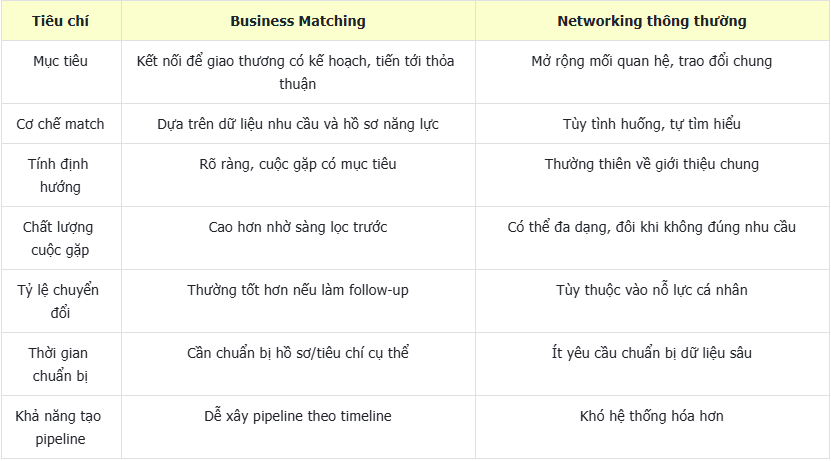
4. Comparison Table: Business Matching vs. Traditional Networking
5. Who Should Participate in Business Matching?
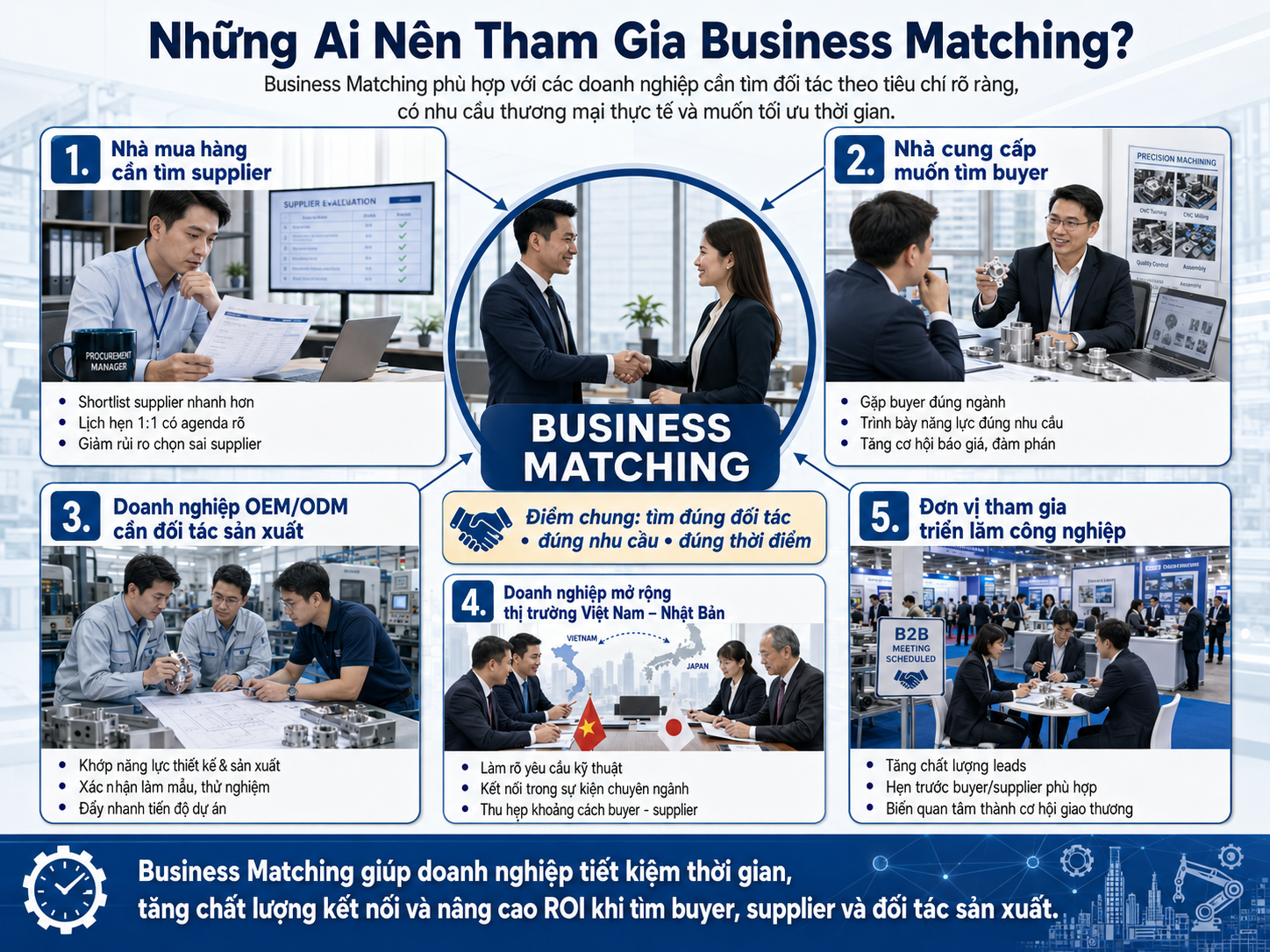
Not all businesses participate in Business Matching with the right needs. However, if you fall into the groups below, Business Matching can yield a very clear ROI.
The common characteristic of these target audiences is: they need to find partners based on specific criteria, have real commercial needs, and want to optimize their time. Below are the most suitable groups:
5.1 Buyers Looking for Suppliers
If you are in a procurement role and need to find suppliers that meet technical, quality, and delivery requirements, Business Matching will help you:
- Shorten supplier shortlisting time
- Organize 1:1 meetings with clear agendas
- Reduce the risk of encountering "non-standard suppliers"
Business Matching acts like a "filter" that helps you go straight to the group capable of meeting your needs.
5.2 Suppliers Looking for Buyers
For suppliers, finding the right buyer is paramount. Not all suppliers truly understand what buyers care about: what standards, what lead time requirements, what payment terms.
Business Matching helps suppliers:
- Create opportunities to meet buyers interested in the right industry/sector
- Present capabilities according to specific needs (already screened)
- Increase conversion potential from discussion to quotation/negotiation
If a supplier has good capabilities but their marketing/positioning isn't quite right, Business Matching helps "bring you to the right negotiation table."
5.3 OEM/ODM Businesses Looking for Manufacturing Partners
OEM/ODM typically have specific requirements regarding design, materials, quality control, and sample lead times. When searching for contract manufacturing partners or manufacturers, Business Matching helps:
- Match design/implementation capabilities with production capabilities
- Confirm prototyping, testing, and refinement capabilities
- Accelerate projects from the ideation phase to production
In OEM/ODM, a small detail in the process can affect the entire timeline. Therefore, pre-matching is very important.
5.4 Businesses Looking to Expand into the Vietnam – Japan Market
If you are targeting the Japanese market (and this can also apply to other markets), Business Matching is often an effective channel because:
- Buyers often have clear standards
- Businesses can clarify requirements immediately upon meeting
- Opportunities to connect within the context of specialized industry events
Many businesses face difficulties when exporting due to a lack of understanding of technical requirements and how buyers evaluate suppliers. Business Matching helps bridge that gap.
5.5 Industrial Exhibition Participants
Industrial exhibitions are a playground for many businesses. If you participate only to exhibit, you might miss the opportunity to "convert interest into business."
Through Business Matching, exhibition participants can:
- Increase lead quality (leads with genuine needs)
- Pre-arrange appointments with suitable buyers/suppliers
- Create more effective narratives (purpose-driven connections)
In short: exhibitions bring "audiences," Business Matching helps you turn audiences into "potential customers."
6. Benefits of Business Matching for Buyers and Suppliers
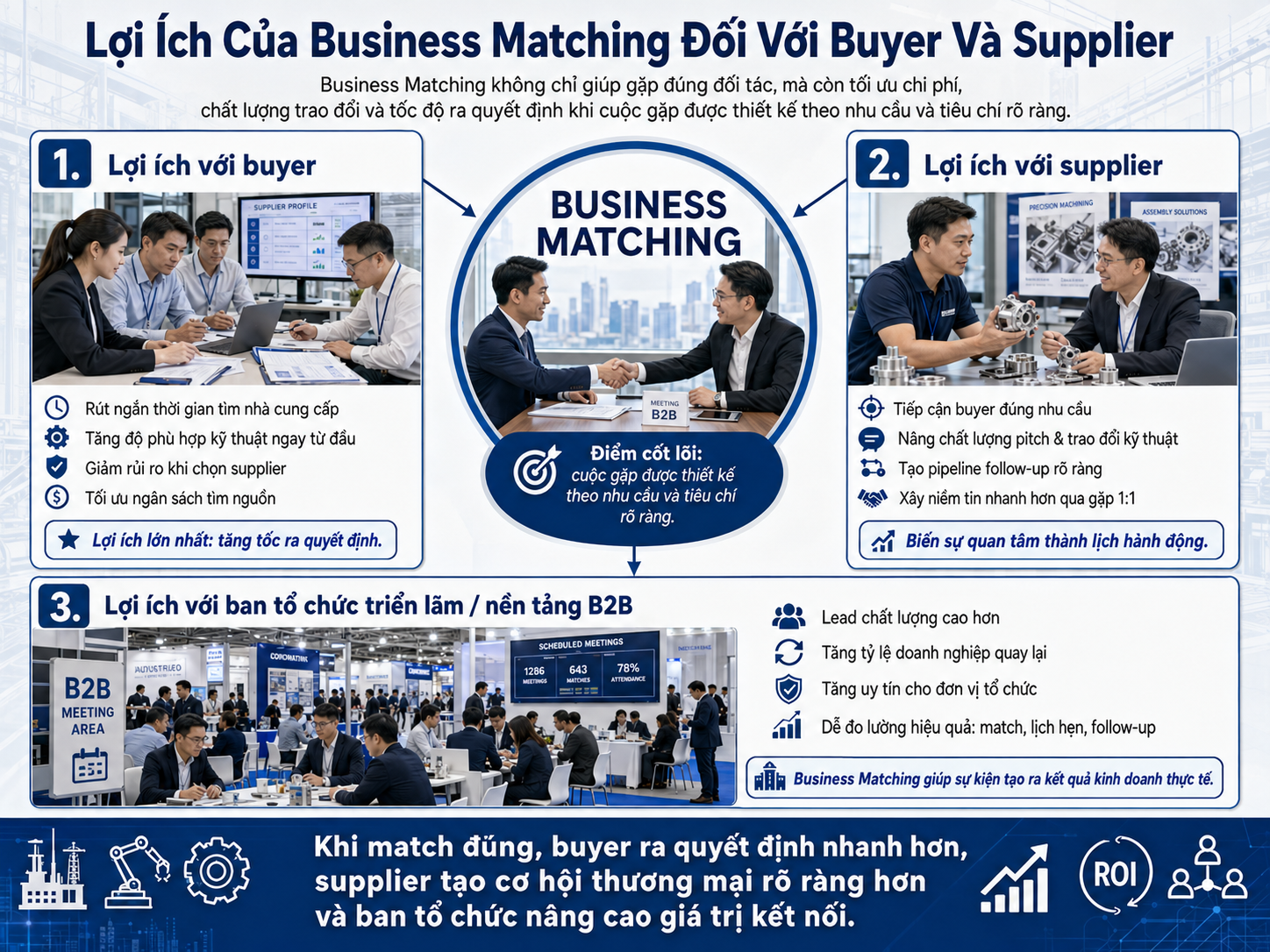
When talking about benefits, people often only think of "meeting partners." But looking deeper, Business Matching offers benefits on multiple levels: from cost efficiency – quality of exchange – to speed of decision-making.
The important point is: benefits don't just come from the meeting itself, but from the meeting being designed according to needs and criteria.
Below are the benefits from each perspective.
6.1 Benefits for Buyers
For buyers, Business Matching helps:
1. Shorten supplier search time: No need to manually filter hundreds of profiles. The matching process helps create a quality shortlist.
2. Increase technical suitability from the outset: When meetings are arranged according to spec requirements, it's easier to confirm capabilities.
3. Reduce risks when selecting suppliers: Opportunities to discuss processes, certifications, and quality control capabilities directly.
4. Optimize budget for marketing/sourcing: Instead of spending time and money on extensive travel/vendor scanning, you focus on targeted 1:1 meetings.
The biggest benefit for buyers is "accelerated decision-making." In a manufacturing environment, making the right decisions early helps reduce project delays.
6.2 Benefits for Suppliers
For suppliers, Business Matching helps:
1. Access buyers with genuine needs: Not everyone buys from every business. Matching helps businesses meet the right group with needs.
2. Improve pitch quality and technical discussions: When buyers have predefined needs, suppliers can easily present "exactly what they need."
3. Create a clear pipeline: Meetings often include specific follow-up steps (quotations, samples, audits…).
4. Build trust faster: 1:1 meetings help both parties understand each other's actual capabilities, not just through documents.
Suppliers often "expend effort" to convert interest into commercial opportunities. Business Matching helps transform that interest into an "action plan."
6.3 Benefits for Exhibition Organizers / B2B Platforms
For organizers, Business Matching helps events have more practical value.
- Higher quality leads: increases satisfaction ratings of participating businesses
- Increased return rate for next year: due to clear connection effectiveness
- Enhanced reputation for the organizing entity: the event is not just an exhibition but generates "business results"
- Easy to measure effectiveness: can track the number of matches, appointments, follow-ups
Organizers who excel at Business Matching invest heavily in business data and follow-up mechanisms. That's why they build "credibility."
7. What Manufacturing Sectors Does Business Matching Cover?
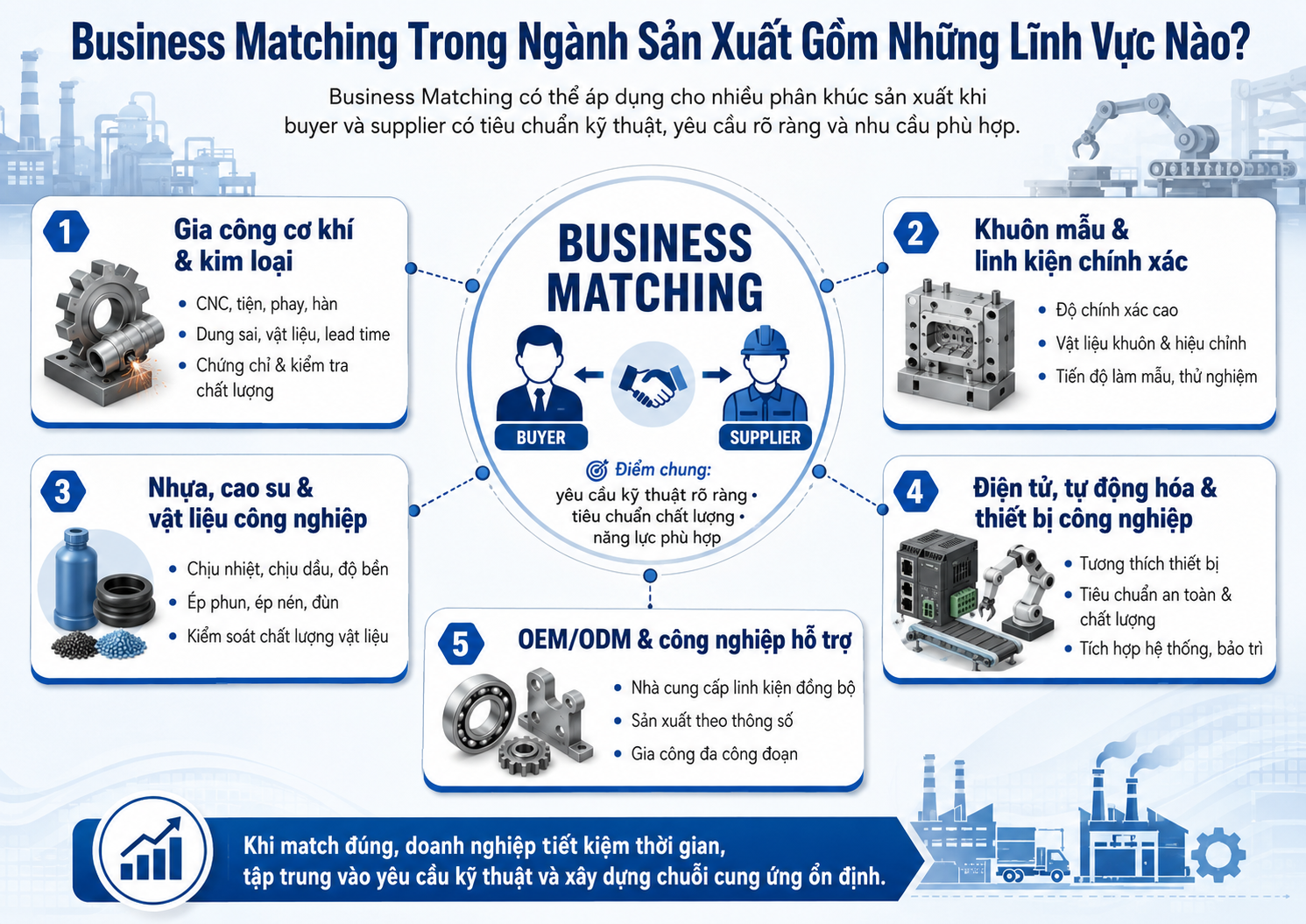
The manufacturing industry is very broad. The good news is that Business Matching can be applied to many segments. Whether you are a mechanical engineering or materials business, electronics or supporting industry, you can input your needs into the matching system.
Common point: all parties require clear technical standards and requirements—this is precisely the "ground" where Business Matching thrives.
Below are the common sectors.
7.1 Mechanical and Metal Processing
This is a high-demand sector in Business Matching because:
- Technical requirements are easily described by parameters
- There are many quality standards and certifications
- Capability assessment processes are quite clear (CNC, turning, milling, welding…)
For example: a buyer needs machined parts, a supplier has CNC capabilities, suitable materials, and quality inspection capabilities. Matching helps the meeting focus on tolerances, materials, machining methods, and lead time.
7.2 Molds and Precision Components
Molds and precision components typically require:
- High precision
- Mold material expertise
- Testing and calibration capabilities
Business Matching is suitable because technical information can be exchanged early and clearly. Instead of "general negotiations," both parties can go straight to the point: accuracy requirements, sample lead times, testing methods.
7.3 Plastics, Rubber, and Industrial Materials
In plastics/rubber, standards may relate to:
- Material properties (heat resistance, oil resistance, durability…)
- Manufacturing processes (injection molding, compression molding, extrusion…)
- Quality control requirements
Business Matching helps connect buyers needing plastic/rubber materials/products with suppliers possessing suitable formulations, machinery, and experience.
7.4 Electronics, Automation, and Industrial Equipment
The electronics and automation sector has highly specific characteristics regarding:
- Equipment compatibility
- Safety and quality standards
- System integration capabilities
Business Matching helps quickly confirm design, production, or integration capabilities. Meetings can focus on technical requirements, integration solutions, and warranty/maintenance conditions.
7.5 OEM/ODM and Supporting Industries
OEM/ODM and supporting industries are the "backbone" of the supply chain. Businesses in this group often need:
- Synchronized component suppliers
- Manufacturing partners according to specifications
- Multi-stage processing capabilities
Business Matching in this segment is effective because requirements can be standardized into a demand catalog. When matched correctly, you can build a stable supply chain instead of constantly changing vendors.
8. What Should Businesses Prepare Before Participating in Business Matching?
Participating in Business Matching without preparation can be like going to a "tender" without a dossier. Businesses will still meet people, but the likelihood of achieving results is lower.
Good preparation helps businesses:
- Be matched with the right partners
- Maximize 1:1 meeting time
- Finalize clear follow-ups
Below is a practical checklist:
8.1 Company Capability Profile
This is the "identity card" of the business. The profile should typically include:
- Company introduction, development history
- Production/implementation capabilities (machinery, technology, capacity)
- Quality certifications (if any)
- Experience in similar projects
- Technical personnel capabilities
Provide information that can be "cross-referenced" with buyer requirements. For example: are there any quality-related certifications? What are the inspection procedures? What is the response time?
8.2 Product/Service Portfolio
Businesses need to define:
- Main products/services
- Scope of customization capabilities
- Which standards product lines meet
- Project examples/case studies
If the business is too broad (does everything), it should select a focused portfolio according to its Business Matching objectives. The clearer the focus, the higher the quality of the match.
8.3 Clear Connection Needs
If you are a buyer, you need to describe your needs specifically:
- Technical specs (dimensions, materials, tolerances…)
- Estimated production volume
- Estimated timeline
- Quality/inspection requirements
- Quotation/negotiation conditions
If you are a supplier, you should state:
- What types of products can you supply?
- How do your capabilities meet standards?
- Level of customization
- Lead time and order acceptance capacity
8.4 Authorized Business Representative
This is a point many businesses overlook. If the attendee only has a general introductory role but no authority for commercial discussions, follow-up can easily be delayed.
A good meeting requires someone who can:
- Answer technical requirements within permissible limits
- Provide quotation/condition information (at least a framework)
- Finalize next steps and timeline
In many situations, simply having the right person at the right meeting can save businesses weeks of external negotiations.
9. How Does NC Network Support Business Matching?
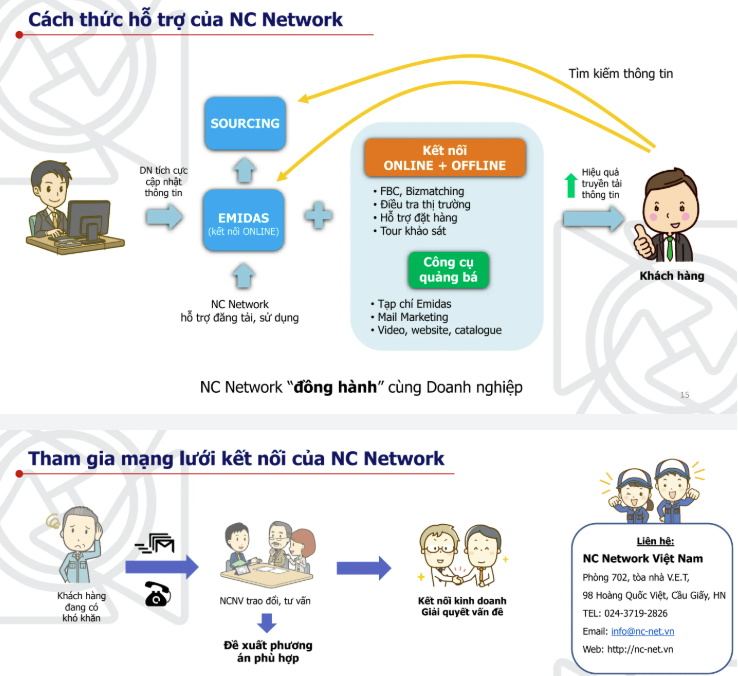
In the process of implementing Business Matching, the role of the accompanying entity is crucial: not just "registering to participate" but also helping businesses prepare the right data, find the correct match groups, and improve meeting quality. .
9.1 Connecting Manufacturing Businesses Based on Actual Needs
Support starts from actual needs — not general ones. NC Network can:
- Survey connection objectives
- Review product/service portfolios
- Standardize demand information to increase accuracy.
- Suggest ways to describe profiles for accurate filtering
If a business's needs description is not clear enough, NC Network will help "translate" manufacturing needs into matching data.
9.2 B2B Manufacturing Business Ecosystem
A strong B2B ecosystem not only has a large number of businesses but also quality industry segmentation and suitability. When participating in Business Matching through NC Network, businesses can:
- Easily access the right industry sectors
- Have more suitable partner options at various levels (from sample testing to long-term cooperation)
- Increase the likelihood of finding the "right fit" partner
This is the difference between self-searching and going through a structured connection network like NC Network.
9.3 1:1 Business Matching Support
1:1 connections are the most important "touchpoint." NC Network can participate in:
- Proposing meeting schedules based on priority criteria
- Preparing information before the meeting
- Reminding schedules and assisting in communicating requirements between both parties
- Accompanying post-event follow-up
A meeting may or may not succeed, depending on the quality of preparation and subsequent engagement. Therefore, having a professional coordinating entity like NC Network often helps increase the success rate.
10. Conclusion
Business Matching is not just about "making more connections," but a process that helps manufacturing businesses find the right partners based on genuine needs—from screening profiles, arranging 1:1 meetings, to post-connection follow-up to convert opportunities into contracts. If your business is looking to expand into new markets or optimize its supply/customer base, consider Business Matching and NC Network Vietnam as an acceleration strategy with clear data and objectives—and remember to thoroughly prepare your profile to maximize meeting effectiveness!
Company Information
Main 3 Products
FBC Asean / Emidas - B2B platform / Emidas Magazine
Phone Number
Homepage URL
NC Network Vietnam: A Sustainable Business Bridge Between Japanese and Vietnamese Enterprises ■ Introduction: Founded in 2010, NC Network Vietnam is a part of NC Network Group, a corporation specializ ...
CONTACT
Contact